LegCo today
Introduction
Under Article 73 of the Basic Law of the Hong Kong Special Administrative Region of the People's Republic of China, the main functions of the Legislative Council are to enact, amend or repeal laws; examine and approve budgets, taxation and public expenditure; and raise questions on the work of the government. The Legislative Council is also given the power to endorse the appointment and removal of the judges of the Court of Final Appeal and the Chief Judge of the High Court, as well as the power to pass a motion of impeachment against the Chief Executive and report it to the Central People's Government for decision.
Composition of the Eighth Legislative Council
Pursuant to the Decision on Improving the Electoral System of the Hong Kong Special Administrative Region passed by the National People's Congress, and the amended Annex I and Annex II to the Basic Law approved by the Standing Committee of the National People's Congress in March 2021, the Eighth Legislative Council is composed of 90 Members, with 40 Members returned by the Election Committee, 30 Members by functional constituencies and 20 Members by geographical constituencies through direct elections.
The election for the Eighth Legislative Council was held on 7 December 2025. The term of office of the Eighth Legislative Council commenced on 1 January 2026. The President of the Legislative Council is elected by and from among Members of the Legislative Council.
Legislative Council Elections
For information on Legislative Council elections, please visit the website of the Hong Kong Special Administrative Region Electoral Affairs Commission.
Functions and Powers of the Legislative Council
As provided for in Article 73 of the Basic Law, the Legislative Council exercises the following powers and functions:
- To enact, amend or repeal laws in accordance with the provisions of the Basic Law and legal procedures;
- To examine and approve budgets introduced by the Government;
- To approve taxation and public expenditure;
- To receive and debate the policy addresses of the Chief Executive;
- To raise questions on the work of the Government;
- To debate any issue concerning public interests;
- To endorse the appointment and removal of the judges of the Court of Final Appeal and the Chief Judge of the High Court;
- To receive and handle complaints from Hong Kong residents;
- If a motion initiated jointly by one-fourth of all the Members of the Legislative Council charges the Chief Executive with serious breach of law or dereliction of duty and if he or she refuses to resign, the Council may, after passing a motion for investigation, give a mandate to the Chief Justice of the Court of Final Appeal to form and chair an independent investigation committee. The committee shall be responsible for carrying out the investigation and reporting its findings to the Council. If the committee considers the evidence sufficient to substantiate such charges, the Council may pass a motion of impeachment by a two-thirds majority of all its Members and report it to the Central People's Government for decision; and
- To summon, as required when exercising the above-mentioned powers and functions, persons concerned to testify or give evidence.
Meetings of the Legislative Council
The Council normally meets on every Wednesday in the Chamber of the Legislative Council Complex to conduct its business while in session. Its business includes: tabling of subsidiary legislation and other papers; reports and addresses; questions; bills; and motion debates. From time to time, the Chief Executive attends a special Council meeting to deliver a policy address and to answer questions on the work of the Government from Members. All Council meetings are open to the public. The proceedings of the meetings are recorded verbatim in the Official Record of Proceedings of the Legislative Council, and they are broadcast live on the website of the LegCo.
Committee System
Through a committee system, Members of the Legislative Council perform the important functions of scrutinizing bills, approving public expenditure and monitoring Government's work. There are three standing committees, namely Finance Committee, Public Accounts Committee and the Legislative Council Supervisory Committee. Bills Committees are formed by the House Committee, as the need arises, to study legislative proposals. Besides, there are 18 Panels which receive regular briefings from the Government and examine the effectiveness of Government policies and measures.
Redress System
The Legislative Council Redress System receives and handles complaints from members of the public who are aggrieved by Government actions or policies. It also deals with public representations on Government policies and legislation as well as other matters of public concern.
In groups of nine, Members take turns to be on duty each week to oversee the system and to give guidance to staff of the Public Complaints Office of the Legislative Council Secretariat in processing cases. During their duty week, Members take turns to be on "ward duty" to meet complainants with appointments (including individual clients and deputations) who wish to discuss their complaints with Members in person.
Legislative Council Then and Now
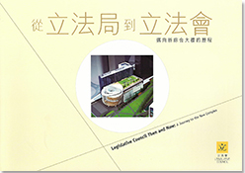
The Legislative Council Commission published a commemorative book, entitled "Legislative Council Then and Now: A Journey to the New Complex", to mark the opening of the Legislative Council Complex ("the Complex").
The commemorative book is divided into two parts. The first part presents the evolution of the Legislature since its establishment in 1843. The second part introduces the planning and construction process of the Complex, and its architectural features, design and facilities.
The commemorative book is presented in traditional Chinese and English. Apart from the online version, hardbound version and paperback version are also available.
How the LegCo Works
A series of educational fact sheets, namely Legislative Council in Brief, is produced to provide brief and informative descriptions of various facets of the Legislative Council. It can enhance public understanding of the functions and work of the Legislative Council.
Introduction
Introduction
Composition of the Eighth Legislative Council
Legislative Council Elections
Functions and Powers of the Legislative Council
Meetings of the Legislative Council
Committee System
Redress System
Legislative Council Then and Now
How the LegCo Works