Banner:Handling of Complaints

bulletWhat are the matters handled under the Redress System?

The Legislative Council Redress System is a system operated by the Legislative Council to receive and handle complaints from members of the public who are aggrieved by Government actions or policies. It also deals with public representations on Government policies and legislation as well as other matters of public concern.

bullet

How does the Redress System operate?

In groups of six, Members take turns to be on duty each week to oversee the system and to give guidance to staff of the Legislative Council Secretariat's Complaints Division in processing cases. In addition, Members take turns to be on "ward duty" during their duty week to meet deputations and individual complainants with appointments.

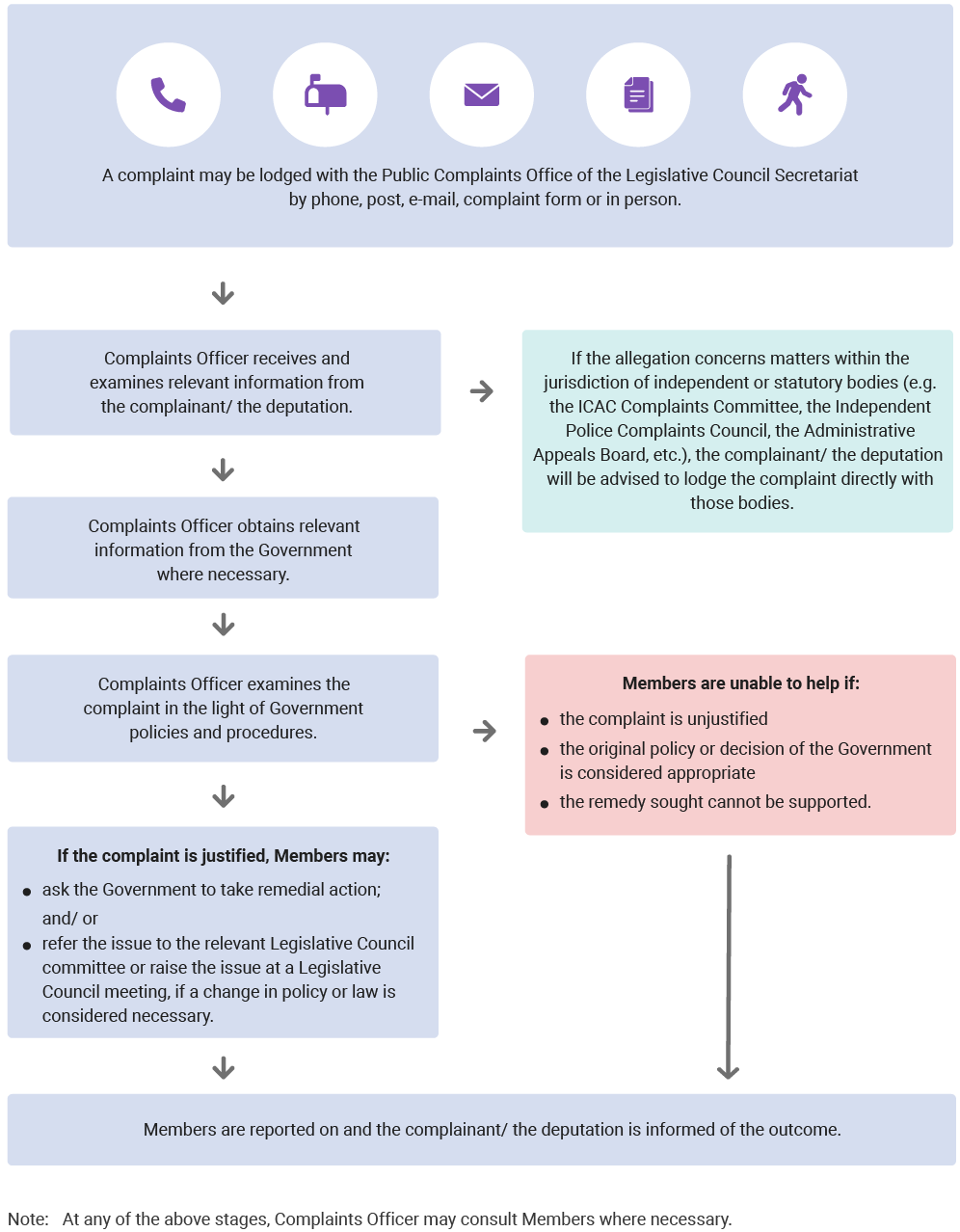
bullet How is a complaint handled?

A complaint may be lodged with the Legislative Council Secretariat's Complaints Division by phone, post, fax, e-mail, complaint form or in person
arrow
Complaints Officer receives and examines
relevant information from the complainant

arrow
If allegation concerns matters within the jurisdiction of independent or statutory
bodies (such as ICAC Complaints Committee, Independent Police Complaints
Council, Administrative Appeals Board, etc.), complainant will be advised to
lodge a complaint directly with those bodies.
arrow
Complaints Officer obtains relevant
information from the Government
arrow
Complaints Officer examines the
complaint in the light of
Government policies and procedures
and consults Members where necessary

arrow
Members are unable to help if:
  • the complaint is unjustified
  • the original policy or decision of the Government is considered appropriate
  • the remedy sought cannot be supported
arrow
arrow
If the complaint is justified, Members may:

  • ask the Government to take remedial action
    and/or
  • refer the issue to the relevant Legislative Council committee or raise the issue at a Legislative Council meeting, if a change in policy or law is considered necessary
arrow
Inform complainant of the outcome


bullet How can requests for interview with Members be made?

All requests for interviews with Members at the Complaints Division of the Legislative Council Secretariat must be made in advance through the Complaints Division. It is for the Members to decide whether and when an interview should be arranged.

An interview between a Duty Roster Member and an individual client will normally be arranged within one week after the Complaints Division has obtained the relevant background information and comments from the Administration on the complaint cases. For an interview between Duty Roster Members and a deputation, it will normally be arranged within 7 to 12 working days after receipt of the detailed submission on the issues raised.

bullet What are the matters outside the scope of the Redress System?

  • request for legal advice or legal services
  • complaints against individual members of the Legislative Council and District Councils
  • private disputes
  • court decisions, matters which are sub judice or could involve criminal charges and matters relating to judicial or quasi-judicial proceedings
  • complaints and matters which are handled by independent or statutory bodies (e.g. ICAC Complaints Committee, Independent Police Complaints Council, Administrative Appeals Board, etc.)
  • labour disputes between individual employees and employers (except those of wide public concern or relating to discrimination of trade union leaders) and
  • matters outside the jurisdiction of the Hong Kong Special Administrative Region

For enquiry about the Redress System or to lodge a complaint, please contact the Complaints Division of the Legislative Council Secretariat.

Opening hours : 8:45 am - 6:00 pm (Monday - Friday)
Hotline : 2526 4027
Fax : 2521 7518
E-mail : complaints@legco.gov.hk
Address : 5/F, Citibank Tower
3 Garden Road
Central
Hong Kong


bullet

How are personal data handled?

Unless a client indicates his/her intention to remain anonymous, where it is necessary for the purposes of handling his/her complaints, all personal data including his/her identity provided may be disclosed to parties who are involved in the handling of the complaint. Subject to the provisions of the Personal Data (Privacy) Ordinance (Cap. 486), clients who have supplied their personal data may request access to and correction of the personal data. Request for personal data access and correction should be made in writing to the Legislative Council Secretariat's Complaints Division with the relevant case number.

bullet Issues referred by DRMs to LegCo committees

bullet Complaint statistics

Between 1 October 2006 and 30 September 2007, the Complaints Division assisted Members in handling 978 cases. These comprised 248 group representatives and 730 individual cases.


bullet Highlight of complaint cases concluded in the second quarter of 2008

A total of 236 cases handled under the LegCo Redress System were concluded in the second quarter of 2008. This included 36 cases involving deputations and 200 individuals' cases. Some of these cases are outlined below:

(a)Elderly property owner-occupiers solicited Members' assistance in urging the Government to provide enhanced financial assistance to the needy to do their building safety and building maintenance works. Members followed up the issue at a case conference with the Hong Kong Housing Society (HS) and the Buildings Department (BD).

HS advised Members that property owners of buildings over 20 years which were outside Urban Renewal Authority (URA)'s Building Rehabilitation Programme areas could apply cash subsidies from HS under the Building Maintenance Incentive Scheme. The subsidies were capped at $3,000 per flat, or 20% of the total project cost, whichever was lower. Initially, the Scheme only benefited estates/buildings with a maximum of 200 flats, but HS had recently reviewed the Scheme, and decided to allow estates/buildings with no more than 400 flats to apply for the subsidies with effect from 1 November 2007 to benefit more estates/buildings. In addition, the Administration would implement the Building Maintenance Grant Scheme for Elderly Owner at a non-recurrent expenditure of $1 billion to help elderly owner-occupiers in need to improve building safety. BD also advised Members that elderly owners aged 60 or above could apply for interest-free loans under the Building Safety Loan Scheme administered by the Department. Applicants should be a recipient of the Comprehensive Social Security Assistance or the Normal Old Age Allowance or were earning income and possessing assets within the prescribed limits. Subject to the approval of the Director of Buildings, elderly singleton or couples eligible for grant of interest-free loan with financial hardship could extend the repayment of loan by 72 monthly installments, or for an unspecified period until the transfer of title of the property or death of the borrower, whichever was the earlier.

Members noted that HS and BD had adopted different income and asset limits for elderly owners applying for the subsidies/loans. At Members' request to standardize the limits, HS agreed to adopt BD's criteria for using the limits for granting the Normal Old Age Allowance by the Social Welfare Department. Members also requested HS to take into account the low income and modest asset of needy elders when administering the Building Maintenance Grant Scheme for elderly owners. To this end, a maximum grant of $40,000 would be available for each eligible elderly owner-occupier within a period of five years. Elderly owner-occupiers aged 60 or above would be eligible for the grant, subject to a simple declaration-based means test. For married couples, they would be eligible if either member of the couple reached the age limit and was the registered owner of the flat, provided that the couple lived in the flat under application and did not possess income and assets above the prescribed limit. The grant could also be used to repay the outstanding loans with BD and URA in relation to building maintenance.

(b)A member of the public complained that the Highways Department (HyD) had allowed certain sections of road surface in the Southern District to be left uneven for a prolonged period due to gas mains laying works carried out by Towngas, causing riding discomfort to road users. The complainant queried why HyD had not executed the reinstatement of the road surface during daytime.

Upon receipt of the Secretariat's referral, HyD advised that Towngas had to carry out their works during off-peak hours to avoid traffic disruption. There was insufficient time for Towngas to await the curing of coarse bituminous layer for laying of fine bituminous road surfacing over the coarse one. It was the coarse bituminous surfacing that caused drivers to experience riding discomfort. At HyD's request, Towngas had strengthened its site supervision to ensure that the coarse bituminous surface was laid to acceptable evenness.

HyD explained that it exercised control over road opening works through the excavation permit system, and required permittees to supervise their works by competent persons. HyD conducted site inspections and instructed Towngas to rectify all defects identified. Towngas subsequently completed the works on all the road sections concerned.

(c)Following murder cases targeting at sex workers earlier this year, a deputation raised concern about the safety of sex workers working in "one sex worker apartments". The deputation suggested that the existing legislation should be amended to legalize the operation of "two sex worker apartment" so as to enhance the personal safety of sex workers. The deputation also suggested that sex work should be "decriminalized" and certain prostitution-related offences (such as "soliciting for an immoral purpose", "living on earnings of prostitution of others", "keeping a vice establishment" and "letting premises for use as a vice establishment") should be repealed.

While sharing the concern of the deputation, Members considered that any amendment to the existing prostitution-related laws would cause public concern. Prior to any changes to be made, the implications of the proposal to amend existing legislation should be examined thoroughly, taking into account the views expressed by different sectors of the community.

On the instruction of Members, the issue was referred to the Panel on Security for consideration. The Panel subsequently held a special meeting on 5 May 2008 to discuss the policy and measures for enhancing the safety of sex workers and another meeting on 8 July 2008 to discuss the review of legislation relating to "one sex worker apartment". Members noted the Administration's view that the current arrangement which allowed the operation of "one sex worker apartment" while criminalizing the operation of vice activities involving more sex workers struck a balance among various relevant considerations. The Police had taken special measures to ensure the safety of sex workers. These included setting up telephone hotlines or appointing liaison officers in individual districts so that sex workers could ask for Police assistance through these channels when necessary, and visits by Police officers to "one sex worker apartments" in individual districts from time to time to enhance communication with sex workers and deter offenders against sex workers.

(d)A deputation comprising parents of school children petitioned Members requesting to review the Childhood Immunization Programme (CIP) administered by the Department of Health (DH). Since the current CIP only comprises vaccines against nine infectious diseases, such as hepatitis B, mumps and rubella, the parents contended that the Administration should regularly review the changes in the global and local epidemiology of vaccine preventable disease and should consider including more new vaccines such as the pneumococcal conjugate vaccine. The Administration informed Members that it had noted the deputation's request for inclusion of more vaccines in CIP. The Administration explained that CIP had been effective in reducing the incidence of many important childhood infections in the territory at a low level. The Scientific Committee on Vaccine Preventable Diseases (SCVPD) under the Centre for Health Protection closely monitored and reviewed the latest position of the World Health Organization on immunization and vaccination, and made recommendations to DH on vaccination matters. DH had in 2006 commissioned a local university to carry out a study to investigate the cost-benefit and cost-effectiveness of incorporating four childhood diseases into CIP, amongst them pneumococcal conjugate vaccine. The results of the study were being reviewed. A decision on whether changes should be made to CIP would be determined having regard to the findings of the study and the recommendations of SCVPD.


bullet Duty Roster Members in the coming weeks

(as at 30.9.2008)

9.10.2008 - 10.10.2008 Hon CHAN Kam-lam, SBS, JP
Hon LAU Wong-fat, GBM, GBS, JP
Hon Albert CHAN Wai-yip
Hon WONG Kwok-hing, MH
Hon Cyd HO Sau-lan
Hon CHAN Kin-por, JP

13.10.2008 - 17.10.2008 Hon Margaret NG
Hon CHEUNG Man-kwong
Hon Jasper TSANG Yok-sing, GBS, JP
Dr Hon Joseph LEE Kok-long, JP
Hon Paul TSE Wai-chun
Dr Hon Samson TAM Wai-ho, JP

20.10.2008 - 24.10.2008 Hon Fred LI Wah-ming, JP
Hon Mrs Sophie LEUNG LAU Yau-fun, GBS, JP
Hon LAU Kong-wah, JP
Hon Frederick FUNG Kin-kee, SBS, JP
Hon CHEUNG Kwok-che
Hon Mrs Regina IP LAU Suk-yee, GBS, JP

*This roster is subject to variation without prior notice.

*All requests for interviews with Legislative Council Members at the Complaints Division of the Legislative Council Secretariat MUST be made in advance through the Complaints Division(Hotline : 2526 4027). It is for the Members to decide whether and when an interview should be arranged.

*An interview between a Duty Roster Member and an individual client will normally be arranged within one week after the Complaints Division has obtained the relevant background information and comments from the Administration on the complaint cases. For an interview between Duty Roster Members and a deputation, it will normally be arranged within 7 to 12 working days after receipt of the detailed submission on the issues raised.

bulletLegislative Council Members' Meetings with The Ombudsman

bulletComplaint Form