For discussion
on 7 June 1996
FCR(96-97)20
ITEM FOR FINANCE COMMITTEE
HEAD 186 - TRANSPORT DEPARTMENT
Subhead 700 General other non-recurrent
Members are invited to approve a commitment of $90 million for engaging consultants to conduct a feasibility study on electronic road pricing.
We need to examine thoroughly the feasibility and effectiveness of electronic road pricing (ERP) as a means to address traffic congestion in Hong Kong.
1. We propose to engage consultants to conduct a technical feasibility study on ERP.
2. Over the past few years, the number of vehicles in Hong Kong has increased at a rate faster than our road infrastructure programme and traffic management schemes can accommodate. This has led to serious traffic congestion along major road corridors. In the short term, we can reduce congestion by traffic management schemes, public transport priority measures and restraining vehicle ownership and usage. In the long term, ERP offers a more efficient, equitable and flexible way of dealing with traffic congestion. Instead of restricting vehicle ownership, it adopts the "user-pays" principle by charging motorists for entering congested areas at busy times of the day.
3. Public consultation on possible means of addressing traffic congestion has indicated general support for adopting the "user-pays" principle. To enable us to make an informed decision on whether we should implement ERP in Hong Kong under current state of technology, we propose to conduct a feasibility study to examine its practicability and to assess its requirements, cost effectiveness and consequences.
4. The proposed scope of the feasibility study comprises -
- developing a transport model to evaluate the effectiveness of ERP in reducing traffic congestion;
- formulating a pricing strategy to include areas to be covered by road pricing, the method of charging, the types of vehicles to be charged, and the charges to be imposed;
- examining the impact of the strategy and recommending measures to enhance its potential benefits and mitigate possible adverse effects;
- investigating the current state of technology for vehicle detection and identification, toll debiting and system enforcement, with special emphasis on safeguarding the privacy of motorists using the system;
- shortlisting preferred technology options and conducting field trials to assess their suitability and reliability; and
- preparing a conceptual design for the ERP system which will cover the technical, legal, administrative and resource requirements.
5. ERP is a new and developing technology involving the integration of transport planning and systems technology. The formulation of an ERP pricing strategy requires elaborate transport modelling techniques to set an equitable toll structure. ERP also demands the use of advanced transport telematics and computer technology for automatic vehicle detection and identification, data transmission and toll transaction. Since Transport Department lacks the necessary expertise in these specialised fields, we have to appoint consultants to undertake the feasibility study.
6. If we do not proceed with the study, we would not be able to establish the feasibility and impact of implementing ERP in Hong Kong. As a result, we will have much less flexibility in managing road use.
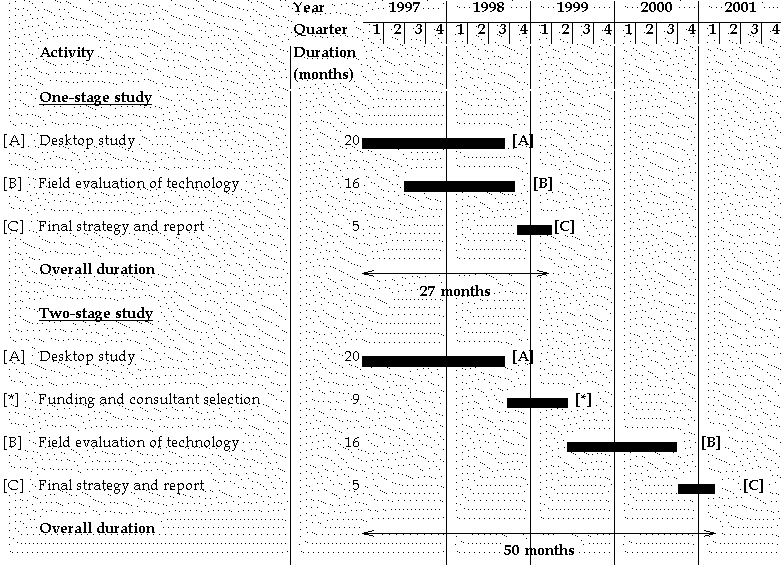
7. We consulted the Legislative Council Panel on Transport on the proposal at its meeting on 14 March 1996. Members expressed concern about the high cost of the study. Some Members suggested that we should carry out the study in two stages with the initial stage covering transport planning and evaluation of pricing strategies and the second stage looking into technology options.
8. We have considered these comments. We have reduced the cost estimate for the study from the original $100 million to the present $90 million. However, we consider that our original proposal of a single integrated study is the most efficient and effective approach for the following reasons -
- The evaluation of technology options is an essential component of the feasibility study. It is not possible to come to a view on whether we could implement ERP without testing the reliability of the technology options, transaction accuracy and enforcement against toll evasion on site; and
- we plan to conduct the field evaluation in parallel with the desktop study (Enclosure 1). Splitting the study into two stages will lengthen the study period by almost two years. In addition, this will increase the total cost because of inflation and the need to reassemble the consultant's team after a break of a few months. Encl. 1
9. We have consulted the Transport Advisory Committee which supports the field evaluation as an integral part of the feasibility study. It has also advised us to conduct the study as soon as possible.
10. We estimate the non-recurrent cost of the feasibility study to be $90 million. The cost estimate includes the staff cost of consultants, the cost of computing facilities, production of materials for presentation, civil and electrical works and hire of vehicles to take part in the field tests. A breakdown of the estimate is at Enclosure 2.
11. We will select the consultants through competitive tendering. The selection criteria will be the knowledge and experience of the study team members in research on ERP systems and technology and in local traffic and transport studies, their appreciation of study requirements, performance record and the fee charged.
12. The study will take about 27 months. We have included an inflation-related allowance of 7.7% per year on a compound basis to cater for general price increases. The computation of the inflation cost is at Enclosure 3.
13. Subject to approval, we plan to phase expenditure as follows -
|
$ million
|
|
1996-97
|
1.69
|
|
1997-98
|
27.34
|
|
1998-99
|
57.74
|
|
1999-2000
|
3.24
|
|
Total
Say
|
90.01
90.00 |
14. In addition, we need to set up a small dedicated team of about 14 staff, including one directorate officer, in Transport Department to steer and manage the study at full annual average staff cost, including salaries and staff on-costs, of $8,783,664.
15. The feasibility study has no direct environmental implication. The implementation of an ERP scheme may affect traffic flow and distribution, with consequent changes to environmental qualities.
16. The study will include an Environmental Appraisal of alternative ERP strategies. This will cover the environmental characteristics of the areas concerned and the likely environmental consequences of implementing the strategy. It will also identify major environmental issues for detailed assessment.
17. In 1985, we commissioned a study on an Electronic Road Pricing Pilot Scheme which showed that ERP had the potential of reducing peak hour trips by 20% to 25%. In view of public concern over possible intrusion into privacy, the Government decided not to proceed with the project. New technology has since evolved to meet concerns over intrusion into privacy.
18. The 1994 Working Party on Measures to Address Traffic Congestion recommended, inter alia, the adoption of the "user-pays" principle by pricing the use of roads, and commissioning a technical consultancy to examine the requirements for an ERP system. During the ensuing public consultation exercise, there was general support for this recommendation. On 27 July 1995, we issued a Legislative Council Brief which set out the decision of the Executive Council (ExCo) on the proposals and our approach in implementing the ExCo decision. We indicated that we would seek the approval of Finance Committee for funds to proceed with an ERP feasibility study.
19. We will brief the Legislative Council Panel on Transport and the Transport Advisory Committee at various stages of the study.
20. Subject to Members' approval, we will commence the proposed feasibility study in January 1997 and complete it in early 1999.
Transport Branch
May 1996
|
Consultants' staff cost
|
Estimated man-months
|
Average MPS salary point
|
Multiplier factor
|
Estimated fee
($ million)
|
|---|
|
(a)
|
Inception report
|
Professional
|
4
|
40
|
3.0
|
0.62
|
|
(b)
|
Transport modelling
|
Professional
Technical | 36
72
|
40
16
|
3.0
3.0
|
5.56
3.73
|
|
(c)
|
Electronic road pricing (ERP) pricing strategy
|
Professional
Technical
|
36
36
|
40
16
|
3.0
3.0
|
5.56
1.87
|
|
(d)
|
Application of ERP
Technology to Hong Kong
|
Professional
Technical
|
13
6
|
40
16
|
3.0
3.0
|
2.01
0.31
|
|
(e)
|
Conceptual design
of ERP System
|
Professional
Technical
|
16
15
|
40
16
|
3.0
3.0
|
2.47
0.78
|
|
(f)
|
Strategy for field evaluation
|
Professional
Technical
|
15
5
|
40
16
|
3.0
3.0
|
2.31
0.26
|
|
Total consultants' staff cost
|
25.48
|
|
Consultants' out-of-pocket expenses
|
|---|
|
(g)
|
Printing of reports and working papers
|
0.61
|
|
(h)
|
Production of materials for presentation
|
0.50
|
|
(i)
|
Computing facilities for transport modelling, computer-aided drafting and document management
|
1.60
|
|
Total out-of-pocket expenses
|
2.71
|
|
Sub-total
|
28.19
|
|
Contingency (10%)
|
2.82
|
|
Overseas duty visits by Transport Department staff
|
0.30
|
|
Inflation-related allowance
|
6.13
|
|
Total for [A]
|
37.44 |
(I) Consultants' fees
|
Estimated man-months
|
Average MPS salary point
|
Multiplier factor
|
Estimated fee
($ million)
|
|
(a)
|
Site supervision
|
Professional
Technical
|
15
10
|
40
16
|
2.1
2.1
|
1.62
0.36
|
|
(b)
|
Assessment of results
|
Professional
Technical
|
2
2
|
40
16
|
3.0
3.0
|
0.31
0.10
|
|
Sub-total
|
2.39
|
|
Contingency (10%)
|
0.24
|
|
Inflation-related allowance
|
0.60
|
|
Total for [B](I)
|
3.23 |
|
Category of works
|
Estimated cost
($ million)
|
|
(a) Automatic vehicle identification and debiting (AVID) system - civil works for overhead gantries *
|
12.00
|
|
(b) AVID system - electronics equipment
|
13.00
|
|
(c) AVID system - control cabinets and cable ducting
|
1.60
|
|
(d) Site offices and preliminaries
|
1.80
|
|
(e) Power supply
|
0.08
|
|
(f) Temporary control centre and communication network
|
2.00
|
|
(g) Traffic diversion works
|
1.50
|
|
(h) Hiring of vehicles for field tests
|
1.50
|
|
Sub-total
|
33.48
|
|
Contingency (10%)
|
3.35
|
|
Inflation-related allowance
|
8.52
|
|
Total for [B] (II)
|
45.35
|
|
Total for [B]
|
48.58 |
|
Estimated man-months
|
Average MPS salary point
|
Multiplier factor
|
Estimated fee
($ million)
|
|
(a)
|
Final ERP strategy
|
Professional
Technical
|
9
4
|
40
16
|
3.0
3.0
|
1.39
0.21
|
|
(b)
|
Final report
|
Professional
Technical
|
6
4
|
40
16
|
3.0
3.0
|
0.93
0.21
|
|
Sub-total
|
2.74
|
|
Contingency (10%)
|
0.27
|
|
Inflation-related allowance
|
0.98
|
|
Total for [C]
|
3.99
|
|
Grand Total : [A] + [B] + [C]
Say
|
90.01
90.00 |
Notes
- A multiplier factor of 3.0 is applied to the average Master Pay Scale (MPS) point to arrive at the full staff costs including overheads and consultants' overheads and profits, as the staff will be employed in the consultants' offices. (At 1 April 1995, MPS point 40 = $51,440 and MPS point 16 = $17,270 per month). A multiplier factor of 2.1 is applied in the case of site staff supplied by the consultants.
- Out-of-pocket expenses are the actual costs incurred. The consultant is not entitled to any additional payment for overheads in respect of these items.
- The figures given above are based on estimates prepared by the Commissioner for Transport. We will know the actual man-months and fees required when we have selected the consultant through the usual competitive lump sum fee bidding system.
Enclosure 3 to FCR(96-97)20
To cater for general price increases and salary adjustments, we have included in the project cost an inflation-related allowance of 7.7% per year on a compound basis. The inflation-related allowance is estimated as follows-
|
$ million
|
|---|
|
1996-97
|
1997-98
|
1998-99
|
1999-2000
|
Total
|
|
(A) Desktop study
|
|
Expenditure (at April 1995 prices)
|
1.57
|
15.66
|
14.08
|
0.00
|
31.31
|
|
Inflation allowance
|
0.12
|
2.50
|
3.51
|
0.00
|
6.13
|
|
|
Sub-total
|
1.69
|
18.16
|
17.59
|
0.00
|
37.44
|
|
(B) Field evaluation
|
|
(I) Consultants' fees
|
|
Expenditure (at April 1995 prices)
|
0.00
|
0.53
|
2.10
|
0.00
|
2.63
|
|
Inflation allowance
|
0.00
|
0.08
|
0.52
|
0.00
|
0.60
|
|
Sub-total
|
0.00
|
0.61
|
2.62
|
0.00
|
3.23
|
|
(II) Works
|
|
Expenditure (at April 1995 prices)
|
0.00
|
7.39
|
29.44
|
0.00
|
36.83
|
|
Inflation allowance
|
0.00
|
1.18
|
7.34
|
0.00
|
8.52
|
|
Sub-total
|
0.00
|
8.57
|
36.78
|
0.00
|
45.35
|
|
(C) Final strategy and report
|
|
Expenditure (at April 1995 prices)
|
0.00
|
0.00
|
0.60
|
2.41
|
3.01
|
|
Inflation allowance
|
0.00
|
0.00
|
0.15
|
0.83
|
0.98
|
|
Sub-total
|
0.00
|
0.00
|
0.75
|
3.24
|
3.99
|
|
Total expenditure
|
1.69
|
27.34
|
57.74
|
3.24
Say
|
90.01
90.00 |
* -- We will design the overhead gantries in such a way that, if it were eventually decided not to implement ERP, they could be re-used as far as possible for other purposes, such as for mounting direction signs.
Last Updated on 2 December 1998


